
Books
• Ascension Now: Implications of Christ’s Ascension for Today’s Church by Peter Atkins (Liturgical Press, 2001)
• The Ladder: Parable-Stories of Ascension and Descension by Edward Hays (Ave Maria, 1999)

The Catholic position on praying for the dead stands on two other doctrines: the teachings on purgatory and the communion of saints. First, purgatory. It's best described as a condition—not a place—between death and heaven. Notice that it's not between heaven and hell, as many folks presume. There's no chance that a person in need of preliminary purification can ever be lost. If a person were lost, they'd already be in hell.
The church teaches that remarkably few people are so holy that they can attain heaven in one leap or so irreconcilably evil that they wind up straight in hell. The deliberate choice to turn from God and grace and not to look back is rarely made, and in any case it's not for us to judge. So what's left for us is to pray for all who go before us in death, especially those known to us personally.
Our belief in the communion of saints is an acknowledgment that death doesn't break the bonds of our relationship to one another. The holy ones are praying for us, and we are praying for the less-than-holy-ones still working out the details of their journey to total union with God. Because God is love, anything unloving has to be left behind for that union to take place. In the "economy of salvation," the currency we use to assist our friends is prayer.
Praying for the dead means more than only saying prayers for them. It can include offering a Mass for their sake, giving alms in their name, or any good work performed for their intention. And should we do these things for bad people, even really bad ones who may have hurt us? Those folks more than any others need our help! Jesus tells us to love our enemies and to bless those who injure us. Certainly we can bless others in death as well as in life.
Praying for the dead is an ancient practice. The Jewish community was doing it two centuries before Christ, as evidenced in the Second Book of Maccabees. Inscriptions in the catacombs of the first five centuries, not to mention ancient liturgies of the church, testify that early Christians fervently followed this practice. Those who have gone before us need our prayers. And someday we will likely need prayers ourselves.
Scripture
2 Maccabees 12:38-46; Luke 6:27-36, 37-42
Online resource
Father Ron Rolheiser, O.M.I. on "Praying for the Dead"
Book
Praying for the Dead: A Holy and Pious Thought by Michael Miller (Our Sunday Visitor: 1994)
Pamphlet
Praying for the Dead (Catholic Truth Society, 2008)

Saints don't come from a cookie-cutter mold. Some attain this status by virtuous living and others for surrendering to a brave and holy death. Some were saint-like from childhood (see the lives of Prince Casimir of Poland, Catherine of Siena, or Maria Goretti). Others were knaves for quite a while first (check out Augustine, Pope Callistus I, and Bernard of Corleone).
Technically, you make the register of saints by undergoing a process known as canonization, which includes a thorough examination of the life and circumstances of the person under consideration. Dying for the faith (martyrdom) is the quickest route into the canon of saints, and posthumous miracles credited to your intercession always help, though they've not always been strictly necessary.
But for every saint who makes the official canon there are thousands and thousands of holy people who fly under the radar of each generation, living and dying in equally astonishing measures of grace. What it comes down to is that canonized saints are held up as examples of virtuous living for the whole church, but the saints of God are more numerous still.
So does that mean you can pray to your kindly departed grandmother? That depends on a sound understanding of how we interact with saints of any kind. Despite what you may have seen or heard, Catholics don't worship saints. Worship and adoration are reserved for God alone in the Persons of the Trinity. What we offer saints is veneration: due honors for their achievements in grace. (Mary, the Mother of God, gets a higher veneration called hyperdulia, but even she is not a candidate for worship.)
We also seek the intercession of saints: their spiritual assistance. Saint Dominic consoled his brothers at his death by reminding them: "Do not weep, for I shall be more useful to you after my death and I shall help you then more effectively than during my life." If your grandmother were a holy woman in life, she'd probably agree with Saint Thérèse of Lisieux, who declared: "I want to spend my heaven in doing good on earth."
Scripture
Matthew 5:1-12; 16:24-25; 2 Corinthians 13:11-12; Ephesians 1
Online resource
Saint of the Day
Books
Sister Wendy's Book of Saints by Wendy Beckett (Loyola Press, 1998)
Holy Simplicity: The Little Way of Mother Teresa, Dorothy Day, and Thérèse of Lisieux by Joel Schorn (Servant Books, 2008)
God's Doorkeepers: Padre Pio, Solanus Casey, and André Bessette by Joel Schorn (Servant Books, 2006)

![]() |
In other words, a huge principle in ritual is to move up and down a sliding scale of magnificence so that it will be clear to the youngest child what’s really important in the full spectrum of what the church believes. The Resurrection of Jesus is the number-one mystery Christians celebrate, so it’s enhanced with three days of intense liturgy (the Triduum), a full week of solemn commemoration (Holy Week), preceded by 40 days of penitential preparation (the season of Lent)—not to forget every celebration of the Eucharist of course.
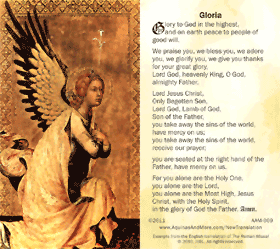
Along with prayer, fasting, and almsgiving to get ready for Easter, the church also fasts from saying or singing the word Alleluia (some traditions have even buried the Alleluia with great pageantry on the Sunday before Ash Wednesday and “resurrected” it again at Easter) as well as singing the Gloria. As one perceptive music minister put it: The church doesn’t sing these great words during Lent for the same reason the church don’t sing Jesus Christ Is Risen Today—until we get there liturgically.
Just as the church refrains from the Gloria during Lent, it does the same during Advent, which is another great season of preparation for a greater mystery, the Nativity of Jesus at Christmas. We don’t sing Christmas carols during Lent (not in church, anyway!), so we don’t sing the mother-of-all-carols, the song of the angels, until then. Gloria in Excelsis Deo is heaven’s response to the glorious birth of Jesus. If the angels can wait until that holy night to sing it, I suppose the rest of us can, too.
The Gloria is an exalted hymn which is not to be replaced by any other at that time in the Mass, so say the norms of the Roman Missal. It adds a “celebratory character” to the Introductory Rites that is better expressed sung than in recitation, and increased in collaboration with a full choir—reminding us of its debut performance. “To sing belongs to lovers,” as Saint Augustine once said. To yearn also belongs to lovers—which is why sometimes the church saves the song until its proper hour.
Scripture
• Luke 2:14; Colossians 3:16; Ephesians 5:19; Acts of the Apostles 2:46-47
Online
• Constitution on the Sacred Liturgy
Books
• At the Supper of the Lamb: A Pastoral and Theological Commentary on the Mass by Paul Turner (Liturgy Training Publications, 2011)
• Days of the Lord: The Liturgical Year, Vol. 2: Lent (Liturgical Press, 1993)

![]() |
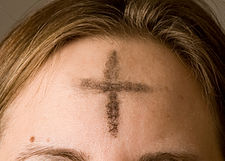
Ashes are an ancient sign of mortification. Often associated with the wearing of sackcloth-a harsh woven-hair fabric used for grain bags-any occasion that warranted the expression of grief, penitence, or supplication might involve scattering ashes, rolling in them, or smearing them on one's person. Such reverse adornment defined the humble spirit of the wearer, and both men and women might employ this sign in times of self-denial. In addition, the shaving of the head or beard might accompany such gestures, and fasting as well. Anyone reluctant to be signed with ashes annually might consider the alternatives!
The prophets recommended such signs when the evil of the times required it. Daniel himself adopted prayer, fasting, sackcloth, and ashes during the period of Israel's exile. In the gospels Jesus reprimands unrepentant Jewish cities by comparing them to pagan cities that would have long ago donned sackcloth and ashes in shame for similar crimes. The message is clear: A definite outward sign of penitence is a bold first step in the actual conversion of the human heart.
So Catholics begin the annual season of their repentance by adopting the mark of ashes. I say "begin": 40 days of fasting, prayer, and charity is expected to proceed from there. Many have noted that Jesus accuses the Pharisees of hypocrisy when they stand on street corners bearing the signs of fasting for all to see. Instead Jesus advises his disciples to wash their faces and anoint their heads while fasting. That is to avoid the temptation to be seen as doing good-and to be rewarded on the spot by the good opinion of others.
In a social climate impressed by the appearance of piety, it would be best to hide such signs. Modern culture, however, is more dazzled by bling, than by the rosary dangling from your rearview mirror. The effect of ashes serves more to remind oneself "that we are dust, and to dust we shall return." With the urgency of mortality clinging to us in every hour, it's wisdom to heed the call each Ash Wednesday not to waste any time but to "repent, and receive the Good News."
Scripture
• Isaiah 58:5-6; Jeremiah 6:26; Ezekiel 27:30-31; Daniel 9:3; Matthew 11:21; 6:5-7, 16-18; 23:5; Luke 10:13; also Genesis 3:19
Online
• St. Leo the Great on Lent, 5th century homily
Books
• Forty Days Plus Three: Daily Reflections for Lent and Holy Week by John J. McIlhon (Liturgical Press, 1989)
• Days of the Lord: The Liturgical Year, Vol. 2: Lent (Liturgical Press, 1993)

Although Catholics are known for their obligatory holy days (such as All Saints’ Day or the Feast of the Assumption), some of the most significant events on the church calendar come with no obligation attached. Among these are the ones that come at the end of Holy Week known as the Triduum, a Latin term meaning “a space of three days.”
The biblical significance of three consecutive days is that of gestation and rebirth: Think Jonah’s three days in the belly of the fish and how it changes his mind about his mission. The ancients viewed three as a perfect number: totality epitomized by the prime alliance of the Trinity. No wonder Saint Paul identifies a trinity of virtues—faith, hope, and love—as the essence of Christian living.
In the Easter Triduum we who put our hope in Christ celebrate our rebirth into eternal life. The Triduum is comprised of three commemorative events celebrated as a single act of liturgy continued over three days: the Evening Mass of the Lord’s Supper on Holy Thursday, Good Friday of the Lord’s Passion, and the Easter Vigil on Holy Saturday evening. In common usage, however, the Masses of Easter Sunday are included as an extension of the Triduum commemoration.
Throughout these high holy days we first recall the events of the Last Supper: the institution of the Eucharist as well as its obligation of discipleship, ritualized by the washing of feet. Enough Eucharistic bread is consecrated on Holy Thursday to last until the third day when we celebrate the Easter Vigil. The tabernacle is then emptied of its precious contents, reserved elsewhere with proper adoration. The Table of the Lord is also stripped bare.
At the Good Friday service the Passion of Jesus is recounted from the Gospel of John and the cross is venerated in a special way by the whole assembly: kissing, touching, bowing. The reserved Eucharist is distributed but no Mass is celebrated on the day we recall the Crucifixion.
After dark on the third day we light the fire of Easter and proclaim “Christ our Light” with a magnificent extended scriptural reading of the highlights of salvation history, culminating with the gospel account of the Resurrection. On this joyful night the church receives new members in the sacraments of initiation: Baptism, Confirmation, and first Eucharist. During the Vigil we also welcome Christian candidates for full communion with the Catholic Church. The big word of the evening says it all: Alleluia!
Scripture
• Jonah 2; Matthew 26-28; Mark 14-16; Luke 22-24; John 13-20; 1 Corinthians 13:13
Online
• Three Holy Days: A Lenten Series on the Easter Triduum from Nativity Catholic Church, Longwood, Florida
Books
• What Every Catholic Needs to Know About Lent, Triduum, and Easter: A Parish Guide to the Paschal Season by Kevin McGloin (Resource Publications, 2001)
• These Sacred Days: Walking With Jesus through the Sacred Triduum by Brother Richard Contino, O.S.F. (St. Pauls, 2008)

![]() |
So where did Lent come from? Let’s start by saying that Christianity embraces one key belief: the resurrection of Jesus Christ from the dead. This central article of faith shapes everything we do as Christians, how we live and die, and certainly how we express our faith in worship. Easter is therefore the primary day of rejoicing. Every Sunday is considered a “little Easter,” a commemoration of how Jesus triumphed over sin and death through the power of God for the sake of humanity’s emancipation from those ancient twin evils that bound it. The entire church year spins on the axis of Easter faith.
In the first three centuries of the church Christians prepared for this mother-of-all-feasts by fasting—between two days to a week depending on local custom. In Rome the “paschal fast” may have lasted as long as three weeks. This extended fast was linked to the preparation of new members for baptism at the Easter Vigil.
By the 4th century a full 40-day period of preparation was observed, imitating the 40-day fast of Jesus in the desert before undertaking his great mission. Fasting and prayer were natural components of the season because that’s how Jesus prepared himself. Almsgiving was added to the practices of Lent as it, too, was a traditional way of making sacrifice to God in the wake of sinfulness. Following a calendar of feasts and seasons dependent on one’s faith is an idea rooted in Judaism. The Law of Moses established fixed times annually to recall the saving actions of God, centered on the commemoration of Passover. A liturgical calendar allowed Israel to practice gratitude and thanks, repentance and conversion, each in accord with the natural seasons, rains, and harvests. A cycle of liturgy also provided a way to instruct new generations about the faith in ritual and storytelling.
Easter, the Christian Passover, was fixed by the Council of Nicaea in 325 to coincide with the first full moon after the vernal equinox. That makes Lent the annual “springtime” of faith, quite literally, as the word Lent means "spring."
Scripture
• Mark 1:12-13; Matthew 4:1-2; Luke 4:1-3; Leviticus 23
Online
• “Grave matters: Take away the Resurrection and the center of Christianity collapses,” article by N. T. Wright
• For fun: Wiki article on “computus,” the complicated story of calculating the date of Easter
Books
• Embracing the Sacred Seasons of Lent and Easter: Daily Reflections and Prayers by Janis Yaekel (Twenty-Third Publications, 2005)
• Living Liturgy: Spirituality, Celebration, and Catechesis for Sundays and Solemnities (Liturgical Press)