

Created in community
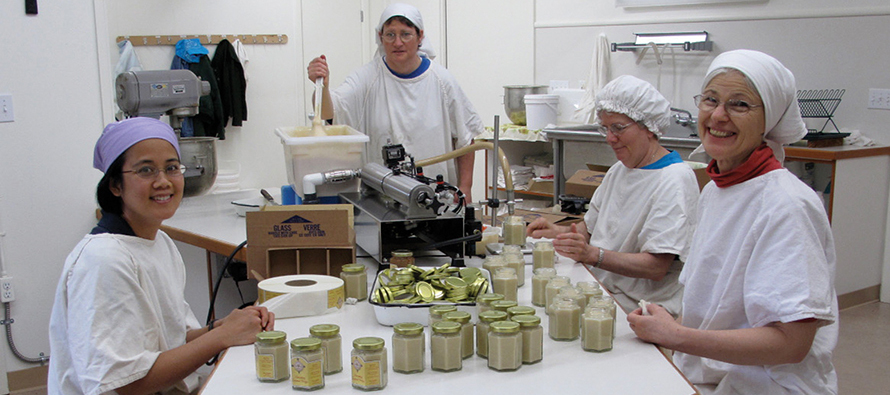
Image: REDWOODS MONASTERY sisters package their Monastery Creamed Honey.
WHETHER YOU'RE hungry—and you probably will be after reading this article—or thirsty; whether looking for a gift or a piece of fine art; want to keep warm, have a picture framed, say the Rosary, or just take a bath, you’ve come to the right place. Here, in their own words, religious men and women talk about the work of their hands created in community.
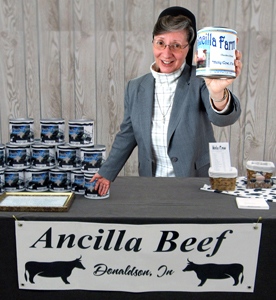 |
| SISTER MARLENE Ann Lama, P.H.J.C. at the Ancilla Farm booth. |
Ancilla Beef and Grain Farm
Ancilla Beef and Grain Farm in Donaldson, Indiana operates in a way that respects the soil. Care is given to raising crops and animals without the use of potentially harmful additives. The meat and grain produced on the farm provide consumers with safe, nourishing food.
As one of the many ministries at the Poor Handmaids of Jesus Christ Ministry Center, Ancilla Beef and Grain Farm flourishes on about 800 acres of land where a combination of row crops, hay production, and beef cattle are raised. The all-natural beef is raised in a caring environment without the use of potentially harmful additives. Ancilla Beef and Grain Farm sells custom cut-to-order beef. All cuts are graded at prime or choice. —Ancilla Beef & Grain Farm, ancillabeef.com
Sprout Creek Farm
In 1982 two teacher members of the Society of the Sacred Heart were looking for a way to incorporate subject matter learned in school into a new and engaging format so that students would experience their education differently and in turn experience themselves and their world differently.
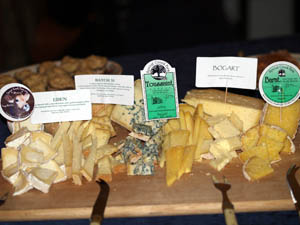 |
| SOME of Sprout Creek Farm’s cheeses. |
They got an opportunity when the society received a donated property in Dutchess County, New York with the stipulation that it remain in agricultural use and be utilized for education and humanitarian purposes. As the farm slowly gained momentum and grew to educate more children, the need arose for a way to supplement income from tuition and fund-raising to support the agricultural dimension as “classroom.”
Encompassing 200 acres, Sprout Creek Farm is really three different entities. It is a working farm, with pasture-raised cows, sheep, goats, turkeys, chickens, and pigs. It is a market, selling award-winning cheeses and farm-produced meats as well as local milk, eggs, vegetables, crafts, and gifts. And it is an educational center, offering day, weekend, and summer programs that help connect young people to the land, the seasons, and the plants and animals that coexist in harmonious rhythm. —Sprout Creek Farm, www.sproutcreekfarm.org
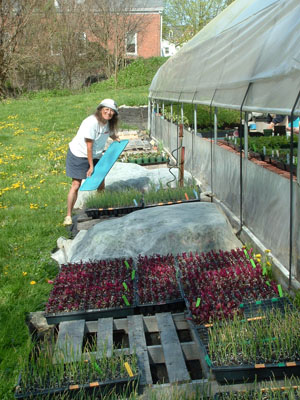 |
| OUTSIDE THE GREENHOUSE on Michaela’s Farm in Oldenburg, Indiana. |
Michaela Farm
The Sisters of St. Francis, Oldenburg, Indiana, operate their “family farm” using natural methods of production. They raise grass-fed beefalo cattle and pastured chickens for eggs and grow a variety of seasonal vegetables and herbs. Michaela Farm’s store sells frozen meat cuts, eggs, honey, fresh produce, potting plants, jams, jellies, and dried herbs.
For more than 155 years the land across the road from their motherhouse has provided the Oldenburg Franciscan Sisters with food. In 1854 the farm was named Michaela Farm after one of the first members of the community and became a supported ministry to continue food production and also to offer educational and spiritual programs and a place for communing with nature. —Sister Claire Whalen, O.S.F., oldenburgfranciscans.org/farm.asp
New Clairvaux Vineyard
The Abbey of New Clairvaux is the first Cistercian monastery in the Americas to grow, vinify, and bottle its own wine. It started its viticultural endeavors in 2000 in the monastic tradition of operating renowned vineyards of the world reaching back as far as the 12th century. The abbey’s property is also home to what was the world’s largest wine-making facility during the 1890s.
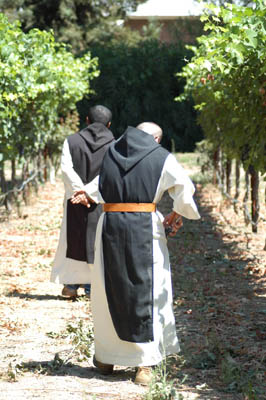 |
| BROTHERS RAFAEL AND PLACID in the New Clairvaux Abbey vineyard. |
Today wines are made in a 120-year-old wine cellar. Our focus is on high-quality wines and grapes suited for this Northern California valley. —New Clairvaux Vineyard, newclairvauxvineyard.com
Earthworks environmental center
Another ministry sponsored by the Poor Handmaids of Jesus Christ, Earthworks is an environmental education center that helps people learn to think and act responsibly in an interconnected universe.
Earthworks, located in Plymouth, Indiana, makes artisan bread—handmade from start to finish. We use healthy, natural (organic where possible) flours, grains, and fruits to make bread that tastes good, is good for the earth, and good for the people who eat it, too. We use no artificial additives or preservatives.
Earthworks also makes a variety of jellies from locally grown fruits. In the production of jelly, as in our bread-making, our emphasis is on ingredients that are cultivated in a way that is good for the land as well as healthy for people.
During the winter months Earthworks makes nutritious soups that are sold frozen by the quart. The soups are made from whole food ingredients, with no additives or preservatives. —Earthworks, earthworksonline.org
Assumption Abbey Fruitcakes
Assumption Abbey is a secluded Trappist monastery in the foothills of the Missouri Ozarks established in 1950 by a group of monks from New Melleray Abbey near Dubuque, Iowa. Through the years the brothers of Assumption Abbey have continued to live by the centuries-old Trappist tradition of contemplation and study, private prayer and common worship, and living by the work of their own hands.
When Assumption Abbey was first developing its bakery, the monks sought the help of world-class chef Jean-Pierre Augé, who at one time served in the royal employ of the Duke and Duchess of Windsor. Mr. Augé’s assistance, and his generosity in providing the recipe and ideas for production, gave the monks the impetus to go forward with Assumption Abbey Fruitcakes.
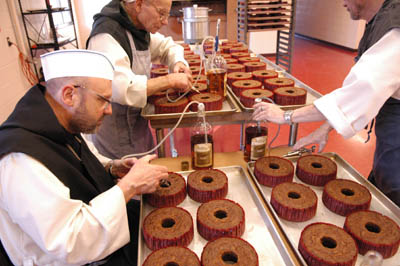 |
| MONKS AT WORK on Assumption Abbey Fruitcakes. |
Assumption Abbey Fruitcakes are a dark, rich, traditional style of fruitcake. They are baked slowly and aged under the careful supervision of the monks. Everything from marinating the fruit to mixing, baking, packaging, aging, and mailing is done right at the monastery by the monks. Assumption Abbey is a way of life that, combined with the careful work of the bakers, ensures a dedication to high quality. —Assumption Abbey Fruitcakes, www.trappistmonks.com
Monastery Mustard
A few years ago the Benedictine Sisters of Mt. Angel, Oregon were searching for ways to balance their budget. Sister Dorothy Jean Beyer, O.S.B., who was prioress at the time, decided the sisters could generate some income by selling something they produced, and she asked me to research product ideas.
One of the sisters in the community, Sister Terry Hall, O.S.B., was making mustard as a hobby and to raise funds for St. Joseph Shelter, a ministry to the homeless she had cofounded in 1988. I knew that the mustard was delicious and sold well at the local Oktoberfest. Sister Terry and I began a months-long process of research and learning about the food industry. Within a year we were ready, and Monastery Mustard was launched.
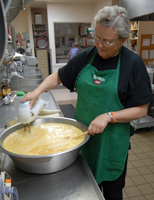 |
| STIRRING UP some Monastery Mustard. |
Initially there were four flavors: Divinely Original, Glorious Garlic, Heavenly Honey, and Angelic Honey Garlic. Within a short time Hallelujah Jalapeño was also added. The following winter Sister Terry entered several flavors in the Worldwide Mustard Competition and won a silver medal for Glorious Garlic. Sister Terry now has developed 14 mustard flavors and is working on more.
“Many of our older sisters help me bottle,” Sister Terry said. “There is a core group that is always there, including Sister Alberta [90 years of age], Sister Agatha [90], Sister Josephine [88], Sister Joseph [76], and the three Rausch sisters [80, 79, and 75].” —Steven Ritchie, Director, Benedictine Foundation of Oregon, monasterymustard.com
Beeswax candles
The Sisters of the Order of Saint Benedict in St. Joseph, Minnesota have been making beeswax candles for 87 years. In 1923 Sister Isabel McDonnell, O.S.B. opened the candle shop, and a line of apprentices followed her. Currently Sister Benet Frandrup, O.S.B. runs the candlemaking operation.
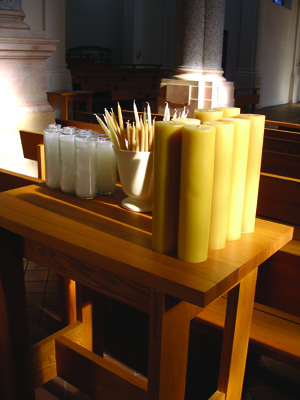 |
| BEESWAX CANDLES in Sacred Heart Chapel at Candlemas before they are blessed. |
The sisters use wax from their own hives, when available, and supplement it with wax purchased from local farmers. Wax also comes from recycled parish and monastery candle stubs. The wax is melted and strained to remove imperfections, including an occasional bee.
For their own chapel and that of Saint Scholastica Convent, the sisters’ retirement facility, the sisters make Easter candles, tapers, altar candles, benediction candles, and dedication candles. They also make candles for sale in Whitby Gift Shop and online.
Candle-making often provides space to think. Sister Margaret Wurm, O.S.B., who learned the process as a novice, remembers cleaning wax late at night: “It’s kind of a peaceful thing to do.” Sister Benet marvels at how a little string grows and grows to become something beautiful, and where it all begins. “Candles are kind of a meditation,” she says. “I think of the bees and how they work together as a community. It reflects our own community.” —sbm.osb.org/store
Monastery Creamed Honey
Since our foundation in 1962 by Our Lady of Nazareth monastery in Belgium, the Cistercian sisters of Redwoods Monastery in Northern California have been engaged in various industries and crafts. In the early days we wove vestments. It soon became impractical to continue weaving as a business, and the sisters began making altar breads. Although that business was almost an instant success, it was extremely labor intensive and the equipment too expensive to modernize.
So in 2000 we looked for a new industry. It needed to fit into our monastic rhythm of prayer, work, and lectio divina [meditative reading of scripture; see page 117 of VISION]. We wanted a business that would be healthy and nourishing for our customers. It had to be a highquality product that was environmentally friendly. In our search we discovered that other monasteries successfully produced creamed honey and so we thought we would give it a try.
The result is Monastery Creamed Honey, a rich and creamy spread made with 100 percent U.S. Grade A natural honey and organic essences. It is used on breads and cereals and in recipes. Creamed honey is available in six flavors. —Monastery Creamed Honey, honeycooks.com
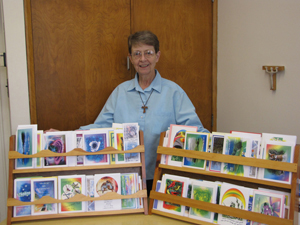 |
| SISTER THERESE JILK, O.S.F. and a display of the greeting cards she designs. |
More honey and other sweet things
One of the most requested items in the gift shop of the Sisters of Saint Francis, Rochester, Minnesota is organic honey, produced under the direction of our beekeeper, Sister Alice Thraen, O.S.F. Other products are also made with the beeswax, including organic lip balm and candles.
The colorful, unique greeting cards designed by Sister Therese Jilk, O.S.F. are also big sellers. These cards often accompany other items found in our shop, including stuffed toy horses, chickens, dolls, and even a hippo. Sister Lillian Silvers, O.S.F. is a seamstress and puts in many additional hours stuffing her creations. Sister Cecelia Rolling is our resident weaver. —Assisi Heights Gift Shop, http://www.rochesterfranciscan.org/whoweare/about-us.htm
Monastery Scents
In 2000 I received a bar of homemade soap as a gift. I was intrigued by it and thought, “I can do this.” So I looked up a recipe on the internet, procured my ingredients, found a small broom closet for my use, and began making soap!
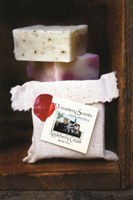 |
| MONASTERY SCENTS soaps from the Benedictine Sisters of Perpetual Adoration, Clyde, Missouri. |
Initially I made soap only for our sisters’ use. Gradually I refined my techniques. The sisters appreciated the soap, so I decided to sew some simple muslin bags and gave a few as gifts. They were well-received and that encouraged me to expand. What began as a hobby slowly became a small hand-crafted soap business called Monastery Scents.
I would pray as I made the soap. I prayed for the people who would use it—that it might bring them hope, joy, healing—whatever graces they most needed.
I have been humbled by the words of gratitude I’ve received. I have heard from soldiers in Iraq who were touched by the prayers that accompany each bar of soap, from a family who used my soap to wash the body of a dying loved one, and from a new mom who insisted my lotions be with her in the hospital as she gave birth. —Sister Cathleen Marie, O.S.B., clydemonastery.org/monasteryscents
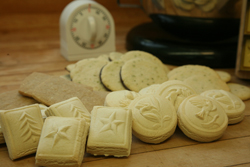 |
| COOKIES from the Benedictine Sisters of Ferdinand, Indiana. |
Simply Divine cookies
At the monastery of the Sisters of St. Benedict, Ferdinand, Indiana, baking cookies is a hands-on process with a personal touch and a divine dimension. Chief baker Sister Barbara Jean Luebbehusen, O.S.B. considers working with the dough a “sacred experience. I feel closer to God when I’m preparing the cookies,” she says.
Our bakery has five Indiana Artisan-designated cookies: Springerle, Almerle, Hildegard, Buttermint, and Buttermint with chocolate. —Simply Divine Bakery, thedome.org/bakery
NunBetter Chocolates and Gift Baskets
The mission of NunBetter, a ministry of the Sisters of St. Francis of the Neumann Communities, is to celebrate the lives of our senior sisters by engaging them in meaningful and productive activities that will not only enhance their lives but also enable them to contribute in a productive way to the financial well-being of the community.
In our tenth year of ministry, NunBetter Chocolates and Custom Gift Baskets provides customers with quality homemade novelty chocolates, packaged for individual sale or in custom-made gift baskets created around a variety of unique themes.
At present we have two “chocolatiers,” Sister Jean Marie Teixeira, O.S.F. and Sister Jane Bourne, O.S.F., the manager, as well as nine sister-volunteers who make the candy. —NunBetter Chocolates and Custom Gift Baskets, nunbetter.org
Second to Nun Framery
The Second to Nun Framery, located at the provincialate of the Sisters of the Holy Redeemer in Huntingdon Valley, Pennsylvania, provides expert framing using new and recycled framing materials; refurbishes old framesl; mounts postersl; and laminates images, among many other custom services such as framing sports jerseys and clay tiles.
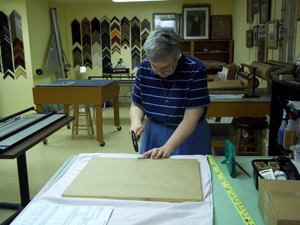 |
| SISTER LINDA ARICO, C.S.R. in the Second to Nun Framery. |
The framery was begun by Sister Jacqueline Long, C.S.R. She enjoyed working with tools and tinkering on projects, so in her retirement years she had the vision to begin a frame shop. Equipment for the shop was donated and purchased as needed and volunteers helped build the necessary furnishings. The original purpose was framing the sisters’ inhouse art as well as meeting framing needs throughout the Holy Redeemer Health System, the sponsored ministry of the congregation.
Sister Linda Arico, C.S.R. continues the tradition, bringing her gifts of technology and organization and learning the necessary framing skills through a mentorship. Under her inspiration and guidance the framery was officially open to the public in October 2009.
Twenty percent of all proceeds go toward supporting the congregation’s mission in Tanzania, East Africa, specifically a new Montessori school for children. In 2010 the sisters hosted the first show to feature the works of local artists. The website includes an online gallery that continues to showcase local artists.
Besides “bringing pictures to life,” Sister Linda said that her greatest accomplishment is building new relationships throughout the surrounding community who never knew the Sisters of the Holy Redeemer. “I love seeing new faces around!” she said. —Second to Nun Framery, secondtonunframery.org
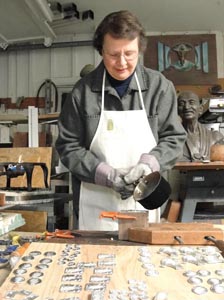 |
| SISTER CATHERINE MUEHLBAUER, S.S.M.N. in the Minsart Studio pouring pewter pendants into molds from original designs. The pewter is then strung and beaded and sold online, in gift shops, and at art and craft shows. |
Minsart Studio
The Eastern Province of the Sisters of St. Mary of Namur, through their own Minsart Studio, make and sell sacred art. The artistic focus is the search for and sharing of beauty as a way of communicating the sacred. Among their products are sculpture, stained-glass, painting, photographic notecards, and pewter casts. —Minsart Studio, minsartstudio.com
Sewing and quilting
I find sewing to be a wonderful creative outlet, a hands-on balance to the listening that I do as a spiritual director and dream-group facilitator. If I can stitch at least a little bit every day, I am much more grounded. Much of my hand-stitching is done while watching the news or visiting with friends and family, so each piece literally has the world and its stories stitched into it, making it all the more sacred and connected to the larger world.
In my more recent venture into quilting, I love playing with colors and textures until they come together in a magnificent way. My quilting projects include:
Gift-wrap and tote bags. I make scraps into small bags with a ribbon to use as an ecological alternative to paper gift-wrap. The bags have traveled around the world to at least the nine countries in which our sisters serve, carried there by our international P.H.J.C. guests.
Quilted sweatshirts are a way to display and make wearable some of the quilt blocks I make. I’ve made close to 200 sweatshirts.Wall hangings and table toppers. Some small-to-medium blocks are stretched over frames as wall hangings. Larger quilt pieces are done with extensive all-over stitching as wall hangings or table toppers. —Sister Joyce Diltz, P.H.J.C. bethanyretreathouse.org
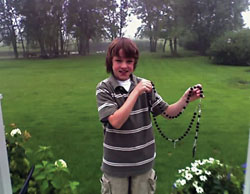 |
| TOMMY WITH his special rosary in honor of his First Communion |
MissionFish rosaries
Valerie Pronger of Boca Raton, Florida purchased one of Sister Adella Blonigen, O.S.F.’s rosaries made from lily pad seeds for her grandson Tommy’s First Communion. Valerie ordered the rosary through MissionFish and had it personalized it with special charms.
A hammer seemed appropriate because Jesus was a carpenter. He also fed the hungry with fish. The tortoise/turtle symbolizes Mother Earth, which Tommy cares for in his own small way. And the rat (Tommy’s first pet) is another of God’s creations. She included the dolphin to remind Tommy of his grandmother and the lily pad story she wrote for him. —Franciscan Sisters of Little Falls, Minnesota, fslf.org/pages/Rosaries
Tags
Related
- Literature makes good people better
- Icons: An age-old entrée into the divine
- Religious communities have deep and diverse roots
- Scientific wonder is God’s handiwork
- Respite and renewal brought to you by religious communities
- Lives that lead to God: Biographies and memoirs
- Religious orders aid and advocate for migrants
- Rural religious take to the highways and byways
- Divine design: The holiness of place
- More prayer spaces of religious communities Read More
Most Viewed
- Find your spirituality type quiz
- Questions and answers about religious vocations
- Celibacy quiz: Could I be a nun? Could I be a brother? Could I be a priest?
- Resources for older discerners or those with physical and developmental differences
- About Vocation Network and VISION Guide