
Questions Catholics Ask

| ➕ | ➕

More questions...and responses

RSS feed button

April 2012 Posts

Ask a question now!

Saint Thomas Aquinas did what, exactly?

Posted by: Alice L. Camille   🕔 Wednesday 18, April 2012 Categories: Church History,Doctrines & Beliefs
Thomas Aquinas
THOMAS AQUINAS, attrib. to Botticelli.

It’s almost easier to list what he didn’t do. In a mere 49 years this 13th-century Dominican friar and later Doctor of the Church became the church’s essential theologian. That Thomas was brilliant is beyond question, but especially in his later writings he betrays an increasingly passionate keenness of vision that might have tempered the earlier intellectualism of his ideas—had he but finished his great Summa Theologica. Death, however, didn’t really put an end to this immense project, Thomas himself did.

Thomas had the advantage of studying under another great Dominican, Saint Albert the Great, and was hugely influenced by Western giants like Saints Augustine and Gregory the Great. But he also sought to mine the Eastern church fathers for their wisdom—in fact, there was hardly a source of truth he didn’t like. Thomas studied and wrote commentaries on scripture all his life. He also read liberally from Christian, Jewish, Muslim, and pagan scholars, convinced there was no contradiction between truth derived from reason as from revelation. Thomas composed The Golden Chain for Pope Urban IV, linking the scripture commentaries of Latin and Greek church fathers together.

His fellow friars considered Thomas both a genius and a warm and kindly man. He was also devoted to the practice of contemplation, which was really what put an end to his writing. After an intense mystical experience three months before his death, he felt incapable of continuing what he now considered a hopelessly inadequate expression of the God he had experienced in prayer. Thomas had defined God in his works as Pure Being: the very essence of Divinity is this Be-ing. The created world and all its creatures were “spoken” and “loved” into a share of this being, which made “friendship with God” the sole purpose for human existence.

Thomas approached divine mysteries with great humility. He qualified even his most stunning theological pronouncements with mental genuflections to reflect their approximate nature only: “to some degree,” “in a certain way,” “as it were.” He rejected theology that denounced the body or the emotions, seeing both equally capable of serving God when well-ordered and disciplined.

His best thoughts on original sin, free will, the role of conscience, divine-human cooperation, the fundamental benefits of a life of virtue, the inner presence of the Holy Spirit, and the nature of salvation in Christ are basic to any parochial school education—whether we recognize them as “Thomistic” or not. It is no wonder that he was canonized a saint within 50 years of his death and named patron of all Catholic universities as well as the “Angelic” Doctor of the Church.

Scripture
Tobit 4:14b-19; Wisdom 6:9-21; 7:7-30 and chs. 8 - 9; Sirach 1:1-29; Proverbs 2:1-11; 3:13-24; 8:1-9:6

Online
aquinasonline.com

Books
Albert & Thomas: Selected Writings, translated, edited, and introduced by Simon Tugwell, O.P. (Paulist Press, 1988)
Thomas Aquinas: Spiritual Master by Robert Barron (Crossroad, 2008)
0 comments  -  Add your own comment  -  Follow my posts  -  Permalink Tags: thomas aquinas

Why did American Catholicism begin in Baltimore?

Posted by: Alice L. Camille   🕔 Tuesday 03, April 2012 Categories: Church History
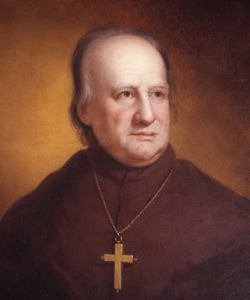
Carroll
PORTRAIT of Archbishop John Carroll.
The answer is a person: John Carroll. The Carrolls were the “First Family” of American Catholicism, arriving in Maryland in 1688. The New World was not hospitable: Catholics were subject to double taxes, deprived of the right to vote, worship, hold office, and educate their children. Masses were held in private, and Jesuits illegally taught in secret schools.

The Carrolls had money, acquired land and influence, and sent their sons to be schooled abroad. Charles Carroll would become the only Catholic signer of the Declaration of Independence. He and his cousin Daniel—who would be one of the two Catholic signers of the United States Constitution—entered Maryland politics after being active on the new national scene. Daniel’s brother John remained in France after finishing his education, taking final vows as a Jesuit in 1771. Rome suppressed the Jesuit order in 1773. John Carroll went home to Maryland, declaring to his mother: “The greatest blessing which in my estimation I could receive from God would be immediate death.”

What he got instead was a diocese. How? Through family connections, John became useful to the Continental Congress in 1776 and made the acquaintance of Benjamin Franklin—a curious man to befriend for someone seeking anonymity. John also defended his faith publicly in the newspapers and published a tract for his fellow Catholics.

In 1783 he organized a meeting of ex-Jesuits in Maryland to petition Rome for the reinstatement of their superior, Father John Lewis. The Holy See consulted that most celebrated American, Franklin, for his opinion. Franklin recommended Carroll instead as the “Superior of the Mission in the thirteen United States.” By 1789, Baltimore, where Carroll had lived since 1786, became the first diocese of the United States with Carroll ordained its first bishop (though Carroll had to go England for his ordination, which took place on August 15, 1790 in the chapel of the Weld family in Lulworth Castle, Dorset).

In a 25-year episcopacy John Carroll accomplished miracles. He pushed for the creation of Georgetown College, opened the first seminary (St. Mary’s in Baltimore), approved the founding of the Visitation Sisters, brought in Dominicans, and encouraged Elizabeth Seton to begin the American Sisters of Charity to educate girls. Not waiting on Rome, he restored the Jesuits in America by affiliating them through the influence of Catherine the Great with Russians who had evaded the suppression of the order.

Carroll also encouraged lay leadership by instituting trusteeship of church properties. He supported Mass in the vernacular, the separation of church and state, and ecumenism among Christian denominations. In the meantime his little diocese grew to include the West Indies and the Louisiana Territory. By the time Carroll died, Baltimore had become an archdiocese overseeing the four sees of Philadelphia, New York, Boston, and Bardstown, Kentucky.

Scripture
1 Timothy 3:1-7; 4:12-16; 2 Timothy 2:1-7; 4:1-5

Online
History of the Roman Catholic Archdiocese of Baltimore

Books
The American Catholic Experience: A History from Colonial Times to the Present by Jay P. Dolan. (University of Notre Dame Press, 1992)
Creative Fidelity: American Catholic Intellectual Traditions, ed. by R. Scott Appleby, Patricia Byrne, and William L. Portier (Orbis Books, 2004)

SOCIALIZE

Follow Us

CALENDAR

Click on a date below to see the vocation events happening that day!