

Catholic sisters thriving in a Muslim world
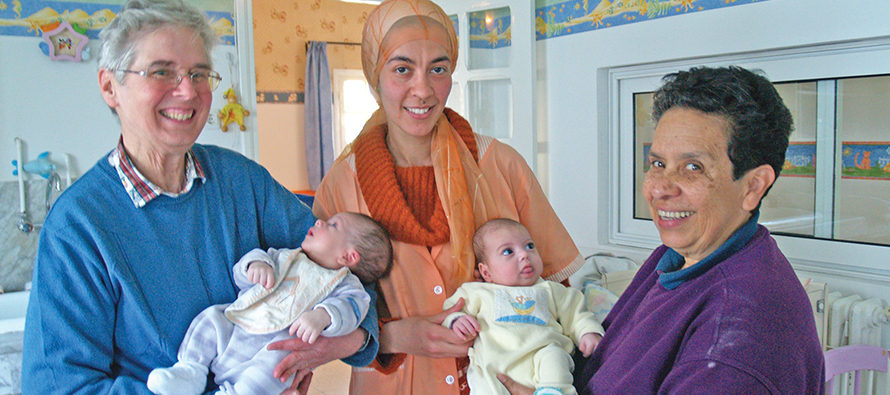
Image: Babies get plenty of love from Sister Agnes Perrin, N.D.S., Feten, a local childcare worker, and Sister Araceli Medina, N.D.S. The Sisters of Notre Dame de Sion cosponsor the nursery in Nabeul, Tunisia as part of an outreach to unwed mothers.
IN MODERN-DAY Tunisia a small community of Catholic sisters helps care for babies whose young mothers face difficult choices. Three members of the international Sisters of Notre Dame de Sion help staff a small nursery in the Tunisian coastal city of Nabeul. Up to 14 infants, from newborns to about nine months, are cared for with the help of the sisters and nine local Muslim women who are professional child-care workers. The nursery provides a loving, homelike environment for babies while their unwed mothers decide if they are able to keep them.
These sisters are part of an impressive network of ministries in Tunisia provided by 13 different communities of Catholic sisters. Schools, learning centers, libraries, kindergartens, nurseries, and health clinics dot the length and breadth of the country. With the exception of tourists and the European expatriate community, all the people served by these institutions are Muslim.
Helping mothers in crisis
The nursery in Nabeul, with its soothing pastel walls, array of brightly colored toys, and cribs arranged according to infants’ ages, is in a quiet residential neighborhood. It receives some financial assistance from the municipality “and mostly from people’s good hearts,” says Sister Araceli Medina, N.D.S., a native of El Salvador, in her native Spanish, adding, “Muslim hearts and Christian hearts!”
Though Tunisia is a model of tolerance and progress in the Muslim world, an unmarried mother often faces rejection from her family, isolation during her pregnancy, and the challenge of raising the child on her own with limited or no financial resources or job skills. While adoption is frowned upon or forbidden in some Muslim nations, Tunisia permits and encourages it if the single mom can’t provide for the child.
This nursery, then, provides a critical option for unwed mothers. Social workers help each mother assess her job skills and education and family support system to determine if she has the means to support and care for the child long-term. And with her infant expertly cared for during this time, the mother can work on developing professional skills and finding a job—a vital element if she wants to keep her baby. At least 50 percent of the mothers opt to keep their babies.
Providing books and tutoring
Another religious order of sisters in Tunisia also focuses its attention on children. In La Marsa, a scenic suburb of Tunis, two Missionary Sisters of Our Lady of Africa (popularly known as the White Sisters) staff a children’s library and learning center.
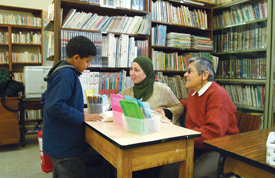 |
| CATHOLIC-MUSLIM cooperation is the norm at the White Sisters’ library and learning center in the Tunis suburb of La Marsa. Here Sister Simone Verges, M.S.O.L.A. and Lynda, the assistant librarian, help Ahmed, 10, check out a book. |
Sister Micheline Laroche, M.S.O.L.A., a native of Cap-de-la-Madeleine in Quebec, Canada, worked for many years with children in a government health center in the African country of Mauritania. Sister Simone Verges, who is from the Auvergne region of France, is a veteran of 48 years of service in Algeria, where she taught and worked with women. The two sisters in La Marsa constitute one of four White Sisters communities in Tunisia, with a total of 14 members.
Both Laroche and Verges bring energy and expertise to their work with the children of Tunisia as well as providing help at nearby St. Cyprian Parish with liturgy and other parish activities. For nominal annual dues, neighborhood children come to use the library and learning center and receive tutoring from the sisters and their lay colleagues, both Muslim and Catholic.
|
How do Catholic priests, brothers, and sisters work in Muslim countries?
In general when a country has adopted an Islamic constitution it means that no proselytizing or open religious teaching by other religions is allowed. Of course there’s a vast difference among Muslim nations as to how this ruling is applied. But how do members of Catholic religious communities spread the Good News of Jesus when they are not permitted to evangelize? One answer comes from the life of Saint Francis of Assisi. In his 1221 Rule for his new order, he stipulated that while the brothers needed permission to embark on a preaching ministry, “let all the brothers, however, preach by their deeds.” That is definitely the mission of the Catholic Church in Tunisia. according to Tunis archbishop Maroun Lahham, “Here in Tunisia, in the Maghreb [the North African nations of Tunisia, Algeria, Libya, Morocco, and Mauritania], the best way of evangelizing is to live,” to be a presence. Though Catholics make up only 1 percent of Tunisia’s 11 million people, and Islam is the nation’s official religion, the former French colony has had a 150-year relationship with the Catholic Church, and that familiarity is one factor in Tunisians’ comfort level with the church and its representatives. But more than length of presence, Lahham said, “I would say it’s the quality of our presence.” The archdiocese and Catholic religious orders sponsor or staff a large hospital, several clinics, more than a half-dozen libraries and study centers, and nine schools from kindergarten through high school and professional courses. Additionally, religious women and men work with government-sponsored institutions and municipal governments in programs for women, children at risk, nurseries, the elderly, and mentally and physically disabled children and adults. Tunisian Muslims also appreciate Catholic institutions because they know the church shares their own moral standards, especially family values and modesty in dress, and will teach and uphold them. “Everybody knows the sisters,” said one Tunisian who works in the tourism industry. Tunisians know what they bring to our people.” —Pat Morrison |
“We help them choose a book to help with their homework,” explained Laroche, “or help them with French or Arabic.” Arabic is Tunisia’s official language, but French is a close second and popular as the language of business. French isn’t formally taught in schools until third grade, so children may have a hard time with the grammar once they start to study it. “Some can speak French well, but can’t write it,” Laroche explained. And although all Tunisian children speak Arabic and can write it very well, they still may need some assistance with it.
The bright, well-stocked library is a busy place. Verges and Lynda, a Muslim woman who is assistant librarian and tutors the children in Arabic, help children choose books for their homework. Delphine Renard, a lay volunteer with the French-based Catholic nongovernmental organization Fidesco, tutors others in French.
The sisters’ library and learning center is also a microcosm of the Catholic-Muslim cooperation and mutual respect that is a hallmark of Tunisia. “People trust us as religious and respect us as educators,” said Laroche. “They know we don’t evangelize, but that we respect their religion and truly care about their children.”
Reaching out to the poor
To find a third group of sisters shaping a Catholic presence in Tunisia, one must leave La Marsa and travel southwest to the middle of the country, to the edge of the Sahara Desert. Here Franciscan Missionaries of Mary live among the unemployed and working poor of the Doualy quarter of Gafsa.
The Franciscan Missionaries of Mary came to Gafsa in 1968 at the bishop’s invitation to help provide health care and social services. They’ve been here ever since. Like many ministries religious communities engage in, the number of services provided outstrips the number of sisters in the tiny Gafsa community. Much of their work involves supporting families and the elderly poor and empowering women.
Carpet weaving, the region’s specialty, is largely women’s work, done at home. But traditionally women have not earned a living wage from it. The sisters have helped the Gafsa women form a cooperative where all the weavers share in the profits. They’ve also helped the women price their wares competitively and market their handiwork more widely.
Sister Renee Mignot, F.M.M. is a nurse and a veteran of many years of service in Tunisia. Before Tunisia’s independence from France, Mignot worked in hospitals, both Catholic and military. But when many of the French left the country in 1956, much of the health care for the people in the outlying areas left with them. The newly independent Tunisian government was just getting on its feet; many needs were still unmet in the cities, even more so in the countryside.
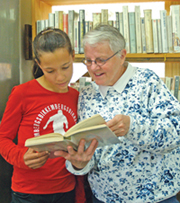 |
| SISTER Micheline Laroche, M.S.O.L.A. helps Fatima, 12, with a French reading assignment at the library and learning center her community, the White Sisters, run in La Marsa, a suburb of Tunis. |
It was then, against prevailing male advice, that the intrepid nun decided she needed to do something. Mignot got a Jeep and took to the road—a young foreign woman and a Catholic sister, alone—to bring medicine to Tunisia’s poorest desert villages. For 12 years, with her Jeep, medical bag, and not much else, she traveled among the poorest mountain communities of Kasserine and Chebika at the northwestern edge of the Sahara. “The people needed the medicine,” she explained undramatically and with a shrug. “I had to go.” Today Mignot serves primarily from the sisters’ modest home, welcoming the poor who come to the door and preparing packages of food and medicine for them.
Sister Monique Decaux had brought her community of Franciscan Missionaries of Mary to Tunisia from France in 1946. Her portrayal of her community’s work could describe the whole mission of the church in Tunisia. “We aim to just be a presence among the people,” she said. “They know us. They know we love them.”
Tags
Related
- African dream: my 17 years in Kenya
- Lessons in love from central Brazil
- Missionary sister falls in love
- Sister Dorothy Stang: Her dying shows us how to live
- Refugee crisis 'a battle for our humanity' in Jordan
- Fighting gangs one youth at a time
- Starting over from scratch
- My mission: To be an instrument in God’s hands
- Beginning again in Ireland
- And Jesus said, “Feed my lambs.” Read More
Most Viewed
- Find your spirituality type quiz
- Questions and answers about religious vocations
- Celibacy quiz: Could I be a nun? Could I be a brother? Could I be a priest?
- Resources for older discerners or those with physical and developmental differences
- About Vocation Network and VISION Guide
Most Emailed

Pat Morrison is a Catholic journalist who has reported widely on the Middle East, Tunisia, and the Muslim world. A vowed lay woman in the Carmelite tradition, she is a member of the Association of Contemplative Sisters. She lives in Dayton, Ohio.