

Holiness is for everybody

Image: Jesus did not stop being God, but though he remained fully divine, he faced life’s challenges just like the rest of us.
THE HIGH SCHOOL SENIORS I teach would cringe at being called holy. The very word secretes poisons like “uninteresting,” “sexless,” “goody-goody,” “unsophisticated”—hardly the path to popularity. Nor does the idea appeal much to older people either. They feel unworthy of a term justified only by a visible halo. Our ideas of holiness are so stringent that even aspiring to it seems presumptuous.
Jesus faced that, too: “ ‘What is this wisdom that has been given him? Isn’t this the carpenter’s son?’ ” (Matthew 13:55). Even slight contact with the less-than-sacred sullies any suggestion of sanctity: “This man welcomes sinners and eats with them!” (Luke 15:3). But here is the key: Jesus loves imperfect people. On that score, all of us qualify. We can, therefore, consider holiness without the distancing, antiseptic “requirements” that make the subject, and pursuit of the reality, inaccessible to ordinary mortals.
Incarnation is key
A constitutive element of Christianity is the Incarnation. Uniquely, the Christian God became completely enmeshed in the material world: “The Word became flesh” (John 1:14). Jesus did not think himself denied by what his coreligionists judged unclean—neglecting ritual washing or consorting with people considered corruptive (prostitutes, lepers, Samaritans). It is also a basic Christian assertion that except for sin, God became in Christ fully human. That means Jesus underwent bodily demands some would consider too degrading for God.
It would also follow that because, of all species, only humans suffer doubt, Jesus had to face the insecurity of commitment to choices without certitude. If not, the temptations in the desert could not have been truly seductive, with no possibility of choosing wrongly. Further, the agony in the garden, where he sweated blood in terror, would have been impossible with full access to a divine intelligence that suffers no uncertainty. Without experiencing authentic uncertainty, Jesus could not have shared that most difficult burden of being human.
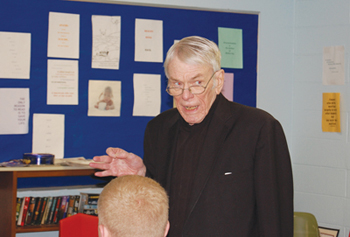
| THE HIGH SCHOOL seniors I teach would cringe at being called holy. |
There is at least an explanation, though it might not convince all. Saint Paul writes that at the Incarnation the son “emptied himself” (Philippians 2:7). He did not stop being God, but though he remained fully divine, he surrendered all divine perquisites, like omniscience and omnipotence, in order to face life’s challenges just like the rest of us.
Jesus’ invitation to all
Jesus’ invitation to the kingdom—to a personal relationship with God here and now—was in no way restricted to the special few. In the parable, when the original guests declined, the host ordered: “Go out into the highways and along the hedges, and compel them to come in” (Luke 14:23). The invitation was not restricted to the already righteous: “It is not the healthy who need a physician but those who are sick” (Matthew 9:12). Nor was it confined to the chosen people: “Go therefore and make disciples of all the nations” (Matthew 28:19), nor limited to the ordained 12 apostles. Jesus loved the rich man who lived the Commandments but could not leave everything (Mark 10:21). Paul—and finally Peter—flung open the doors indiscriminately: “There is neither Jew nor Greek, neither slave nor free man, neither male nor female; you are all one in Christ Jesus” (Galatians 3:28).
If all that is true, one has ample justification to examine holiness with less stringent requirements than conventional wisdom might call for. To be judged holy—or at least trying to achieve some semblance of it—one need not be flawless, destitute, or virginal. True, to declare publicly that someone is a saint, the church must scrutinize that life meticulously. But one need not be a World Series Most Valuable Player.
Saint Irenaeus said in Against Heresies: “The glory of God is humanity, fully alive.” What separates humans from other animals is the potential to learn and to love. Other animals know facts; a stag pursued by hunters knows that danger is behind him, but so far as we know he does not ask why: “What did I do to those guys?”
We have at least the capacity (if we use it) to understand. Other animals can give their lives for their young. But we can give our lives (often without dying) for people we do not even like at the moment. Ask any parent or teacher. Can we entertain the possibility that our God-given purpose is to prepare a fully realized recipient for the gift of holiness? Nor is that role limited to purging defects, as so many were taught, but more important to amplify those potentials of knowing and loving. “Let your light shine before people in such a way they may see your good works, and glorify your Father in heaven” (Matthew 5:16).
The qualities of a saint
As the Book of Job shows clearly, the architect of the universe has no need to check his plans with anyone beforehand, not even any official religious body. If God is content that an individual is trying his or her best (for the moment) to fulfill God’s hopes in raising humans above animals, that person qualifies as a saint, even if the Vatican has not gotten around to ratifying God’s judgment. That person does not need the external, ritual bestowal of baptism or any other symbolic sign of acceptance. A moment’s reflection should make God’s unchallengeable assessment obvious, because no intelligent creature would accept a God less kind than he or she is.
We all know unchurched people who are the salt of the earth, as Jesus hoped his disciples would be (Matthew 5:13). You can call them when you are stalled on the freeway at 2 a.m. They will tell you when you are too pushy or flirtatious or tipsy, and not hesitate because you might stop liking them. It is difficult to imagine them excluded from a kingdom that welcomes Mary Magdalene and the good thief.
Nevertheless, it is easier for ordinarily self-doubting people if some outside authority validates their inner sense that they are trying their best. Baptism and confirmation are incalculably precious assurances of inclusion in a second family that will welcome us back, no matter what. Reconciliation gives a concrete pledge that we can never make ourselves so unworthy that we negate what Jesus did for us.
Inadequacies no barrier
If God so generously offers the merits of Christ to make up for our inadequacies and indiscriminately invites us to holiness, God does not expect anything close to undiluted purity of motive or action when asking us to lead holy lives. This is borne out on page after page in scripture, despite our penchant for sanitizing saints regardless of what they did. Abraham, our “father in faith,” pandered his wife into another man’s harem. Jacob scammed his brother’s birthright. Even the unassailable Moses stammered for some time trying to weasel out of God’s call. David, the ancestor of the Messiah, was a conniving adulterer and murderer. Unthinking piety turns the apostles into bowdlerized saints instead of a passel of Keystone Kops, often bumping into one another in pursuit of personal advancement.
Reflect on the down-to-earth holy people you know—usually not the fastidiously devout, the cautious observers of the tiniest rules, the judgmental. Think of the millions of men and women who refused to surrender their souls in Nazi camps; those who bear with dignity the slow impoverishment of disease; the patient teacher who taught you to write. There is an almost palpable serenity about such people. They seem unafraid and open, indiscriminately caring, inwardly coherent and focused. Their holiness is their wholeness, their altogetherness.
The source of that equanimity seems to be a special relationship with the ultimate being and, reciprocally, a freedom from the self-concerned values of this world. That genuine connection with a transcendent energy source makes them divinely restless, unwilling to ignore or yield to elements of human behavior that conflict with the obvious intentions of a provident God: exploitation, ignorance, neglect of the marginalized, and corruption anywhere.
Conversion needed
Accepting holiness requires, at the very least, conversion in the sense of transformation, coming to a halt to ask, “Is this the truth? Is this where I want to go?” fiercely refusing to be bamboozled by mesmerizing media that promise instant gratification but deliver ashes; rejecting the investment of your heart and hopes in anything that cannot defy death; uprooting one’s soul—one’s self—from the trivial and transitory and engrafting it into the eternal. It is not a static achievement but a continued evolution of soul that in authentic holiness becomes contagious. Saint Paul suggests ordinary holiness should be easily evident: “The fruit of the Spirit is love, joy, peace, patience, kindness, goodness, faithfulness, gentleness, and self-control” (Galatians 5:22).
If we trim inflated notions of heroic holiness that lead us to negate God’s prodigal invitation, we might fulfill the hope that motivated the incarnation, death, and resurrection of the Son of God: “That you may have life, and have it more abundantly.”
Holy is really a synonym for successful, fulfilled, well-rounded. Each of those words describes what God intended fully evolved human beings to be. Each of us must discover the directions in which we will find fulfillment. This is—or ought to be—the goal of a lifelong education: not merely to make a living but to find out what living is for. With that understanding, it becomes more obvious that holiness, the full evolution of humanity, is not inaccessible to ordinary people, but it is also not commonplace. It takes a lot of effort. “Holy” need not be confined to achievement. Just striving is enough.
Reprinted in condensed form from America, July 30-August 6, 2007, with permission of America Press, Inc., © 2007. All rights reserved. For subscription information, call 1-800-627-9533 or visit americamagazine.org.
Tags
Related
- Explore the different types of vocations
- How to prepare for consecrated life
- The essential facts about secular institutes
- Obstacles and options for older discerners
- Nine reasons chaplaincy training might be right for you
Most Viewed
- Find your spirituality type quiz
- Questions and answers about religious vocations
- Celibacy quiz: Could I be a nun? Could I be a brother? Could I be a priest?
- Resources for older discerners or those with physical and developmental differences
- About Vocation Network and VISION Guide
Most Emailed
 Father William J. O’Malley, S.J. is a teacher of English and religious studies at Fordham Preparatory School in the Bronx, N.Y.