

How a 16th-century nun guides me in religious life
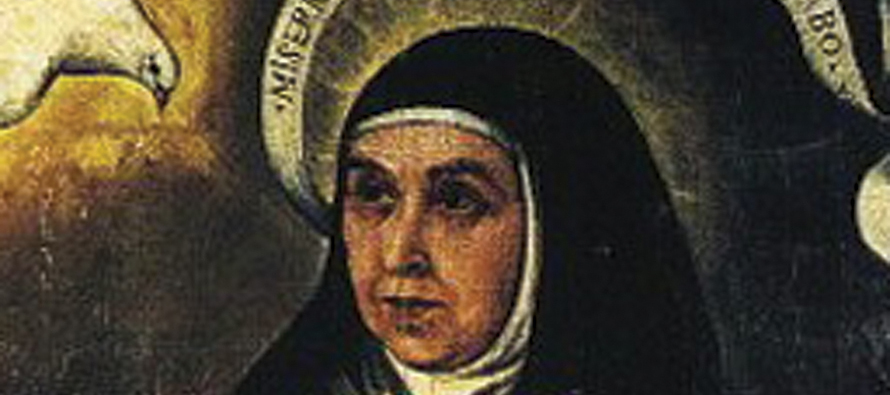
Image: Whenever I have questions about prayer or don’t quite understand how the Spirit is moving in my life, I pray and seek guidance from Teresa.
AS A 21ST-CENTURY NUN ministering in the digital world, I try to stay on top of the latest technology so that I can best serve the people who visit my blog, ANunsLife.org. But when it comes to living religious life, I’m old-school. One of my greatest mentors is Saint Teresa of Avila, a 16th-century Carmelite nun from a small town in Spain. Teresa is best known for her writings on prayer and reforming the Carmelite order. She is venerated today as a great saint and Doctor of the Church.
Personal connection to Teresa
My first encounter with Teresa was in grade school, when I needed to take a saint’s name for Confirmation. Teresa seemed as good a name as any. I chose her name and then pretty much forgot about her.
But Teresa did not forget about me. Over the years she remained with me, waiting, it seemed, for me to come by her convent cell and chat awhile.
That day came one fall morning in a graduate theology class in which I was introduced to Teresa’s writing. I took an immediate liking to her. She wrote of ordinary, everyday stuff and of profound theological truths. I discovered that Teresa was a wise woman from whom I could learn much about the spiritual life. At that time I had no idea how important she would be for me in the months and years ahead, when my world would be turned upside down by the possibility that maybe, just maybe, God was calling me.
I first read Teresa’s classics, Interior Castle and Way of Perfection, because I needed to write a paper for a class. But soon I began to realize that Teresa’s words were there not only for me to study. I felt a personal connection. Through her writing she was alive to me. She gave me insights not only into our shared Catholic faith but into my own self and how I was living the gospel.
Later in my studies, when I began considering religious life, I returned to Teresa. I wanted not to study her writings but to see what she was like as a nun. I wondered if she had any of the same questions I now had. Did she know for certain that God was calling her to religious life? Did she resist or doubt or panic at the thought? Hoping to get a glimpse into how she realized her call from God, I turned to her more autobiographical work, The Book of Her Life.
Doing something big for God
One of Teresa’s first mentions of wanting to give her life to God comes in a story from her childhood. Teresa, at the tender age of seven, was inspired to do something big for God. We’re not talking here about making crosses out of clothes pins. Teresa decided that she and her brother ought to become martyrs because that was the quickest way to heaven.
So they set out in search of unbelievers so that they could “beg them, out of love of God, to cut off our heads.” But no sooner had the children started their journey than an uncle caught sight of them and promptly returned them to their mother. Teresa surrendered her dream of martyrdom, concluding that “having parents seemed to us the greatest obstacle.”
She resigned herself to an ordinary childhood. Still, she clung to the desire, however innocent and immaturely expressed, to do something big for God. She took consolation in pretending to be a nun: “When I played with other girls I enjoyed it when we pretended we were nuns in a monastery, and it seemed to me that I desired to be one, although not as much as I desired [becoming a martyr or a hermit].”
This episode in Teresa’s life reflects the difficulty of feeling called to something, but not knowing exactly what. When I felt called I thought maybe it meant joining the Jesuit Volunteer Corps or dedicating myself to marriage and raising a family. Not convinced that religious life was for me, I tested many alternatives. But no matter how good they were or how much I welcomed them, they didn’t seem to fit.
No substitute for real nuns
Just as Teresa had romantic notions about what it meant to be a martyr or a nun in the 16th century, so, too, I had some skewed ideas about religious life in this century. My ideas came from a number of sources; actual experiences with nuns as an adult wasn’t one of them. It occurred to me that I hadn’t considered religious life before because I didn’t know what it was about. My lack of accurate information left me with a superficial understanding of religious life and the women and men who lived it.
Teresa’s life shows the importance of firsthand experience with people in religious life. When Teresa was 12, her mother died, and she was raised by her father and older sister. When her sister left the house to get married, Teresa’s father decided to send her to a convent school to be taught by the nuns and live with them. Teresa wrote of her initial unhappiness with this arrangement, mostly because she was afraid the nuns knew that she didn’t always live an exemplary life. Within days, however, her unhappiness gave way to peace, and she began to feel at home.
“My soul,” she wrote, “began to return to the good habits of early childhood, and I saw the great favor God accords to anyone placed with good companions.” While living with the nuns, Teresa found one who became a mentor and friend. This nun talked to Teresa about the things of God and even shared with Teresa her own path to religious life. This personal experience lead Teresa to free herself “from the antagonism that I felt strongly within myself toward becoming a nun.” Still, Teresa notes, “I had no desire to be a nun, and I asked God not to give me this vocation.”
Throughout my discernment about religious life, I took great comfort in Teresa’s words. How many times did I pray to let this vocation pass me by? Yet even then I felt as attracted to the life as I was terrified by it. What kept me going were the Servants of the Immaculate Heart of Mary sisters around me who encouraged me and who, by their lives, showed me the great gift and adventure of religious life. Had I not had a direct experience with nuns, I might never have been open to the possibility of religious life.
A leap of faith
Teresa spent a year and a half living with the nuns. Still, she resisted becoming one. Though obviously attracted to the life, she needed time to adjust to the possibility of God calling her. Like Teresa we are often given the same challenge of imagining our life in a different way. She says little about how or even if she resolved her questions, but we do know that she decided to become a nun anyway. She was able to set aside her doubts and fears and respond to God’s call.
This decision to become a nun, however, didn’t mean that Teresa’s life was easy once she made it. Explaining her call to family and friends proved to be a challenge. Her father so loved her that he couldn’t imagine letting her leave for the convent until after he died. Nothing Teresa said or did could change his mind.
But she wished to remain true to her call from God. She knew herself well enough to realize that if she didn’t pursue God’s call now, she might never do it. So early one morning Teresa quietly left her father’s house for the convent: “I remember, clearly and truly, that when I left my father’s house I felt that separation so keenly that the feeling will not be greater, I think, when I die. For it seemed that every bone in my body was being sundered.”
The pain which Teresa wrote about here is real. Whether it be family or friends, careers or possessions that we want to hold onto, God’s call is all-encompassing. It is a call to be open to radical change in our lives, if that’s what God asks of us.
Filled with a new joy
Teresa entered the Carmelite Monastery of the Incarnation in 1533, took the habit, and eventually professed solemn vows as a Carmelite nun. Her initial struggle gave way to a lasting joy: “[God] gave me such great happiness at being in the religious state of life that it never left me up to this day, and God changed the dryness my soul experienced into the greatest tenderness. All the things of religious life delighted me, and . . . I . . . experienced a new joy that amazed me.”
When I first began considering religious life, I never would have imagined I’d experience this “new joy” of which Teresa wrote. But the experience of responding to God’s call and eventually professing my vows as an I.H.M. sister was a joy that I’d never felt before. I felt like a new person, yet more myself than ever.
Trusting always in God
All along the way it helped to have Teresa by my side. Today she is still very much a companion. Sometimes I turn to her writings for encouragement, other times for help in a pastoral or theological quandary. Whenever I have questions about prayer or don’t quite understand how the Spirit is moving in my life, I pray and seek guidance from Teresa.
Even Teresa’s own tangles with God (once, when complaining of her suffering, Teresa heard Jesus respond, “This is how I treat my friends,” to which she rejoined, “No wonder you have so few!”) give me assurance that my struggles are not out of the ordinary and that there is a way through the darkness.
Although I have known Teresa for many years now, I continue to discover new things about her. Recently I read a book of her letters. They reveal a woman who was deeply committed to a contemplative life but who was, of necessity, engaged in what one commentator calls “a maelstrom of activities.” Sometimes this maelstrom got the best of her. Wrote Teresa, “With so many duties and troubles . . . I wonder how I’m able to bear them all.”
As a religious sister I can identify with this constant balancing of prayer, ministry, and community life. It is both a joy and a challenge to live this life. When we live our true calling—whether it be to religious life or another way of life—God calls us to our best selves. Living out our vocation often summons strengths and gifts we didn’t even know we had.
I’m sure on more than one occasion Teresa was surprised to see how things worked out or what paths opened up that she could have hardly imagined. Perhaps some of the best advice that Teresa has ever given me is to trust always in God, even when things are tough or unclear. She reminds me that determination is indeed a virtue and a necessity in the life of faith.
“Have great confidence,” she wrote, “for it is necessary not to hold back one’s desires, but to believe in God that if we try we shall little by little, even though it may not be soon, reach the state the saints did with his help. For if they had never determined to desire and seek this state little by little in practice they would never have mounted so high.”
Tags
Related
- A vocation found on the low road: Profile of Sister Thanh Pham, S.S.M.O.
- Missioned to make connections
- Need-to-knows about becoming a nun
- An art teacher is drawn to something greater: Profile of Sister Lisa Perkowski, I.H.M.
- What a flock of sheep taught its shepherdess
- Sister Vilma’s fearless faith
- Seeing God in a child’s smile: Profile of Sister Marie Elizabeth Jerry, S.S.F.
- Bringing sacred healing to hurting communities
- Sisters help Uvalde move from trauma to trust
- Camaraderie at its best: Profile of Sister Kristine Fernandes, C.S.J. Read More
Most Viewed
- Find your spirituality type quiz
- Questions and answers about religious vocations
- Celibacy quiz: Could I be a nun? Could I be a brother? Could I be a priest?
- Resources for older discerners or those with physical and developmental differences
- About Vocation Network and VISION Guide
Most Emailed
 Julie Vieira, I.H.M. belongs to the Sisters, Servants of the Immaculate Heart of Mary. She works at Loyola Press in Chicago and blogs at http://anunslife.org/.